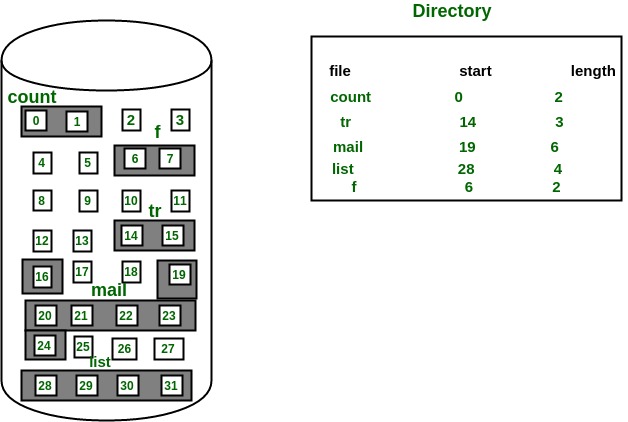
Contiguous File Allocation is one of the most straightforward file storage techniques used in operating systems. It stores each file in a set of contiguous disk blocks. The operating system only needs the starting block address and the file length to access or manipulate the file.
This method is especially effective for files that are accessed sequentially, such as media files, logs, and text documents. Since all parts of a file are placed together on the disk, read/write operations are fast and efficient with minimal seek time.
However, the major downside is external fragmentation. As files are created and deleted, gaps may appear, making it harder to find large enough contiguous spaces for new files. Also, extending a file can be problematic if the next blocks are already occupied.
Advantages
- Simple and easy to implement.
- Fast access for sequential reading and writing.
- Minimal overhead in maintaining file metadata.
- Efficient disk I/O due to reduced seek time.
Disadvantages
- External fragmentation leads to inefficient use of disk space.
- Difficult to grow files if adjacent space is not available.
- Not suitable for dynamic or frequently modified files.
- Requires knowing file size at creation time.