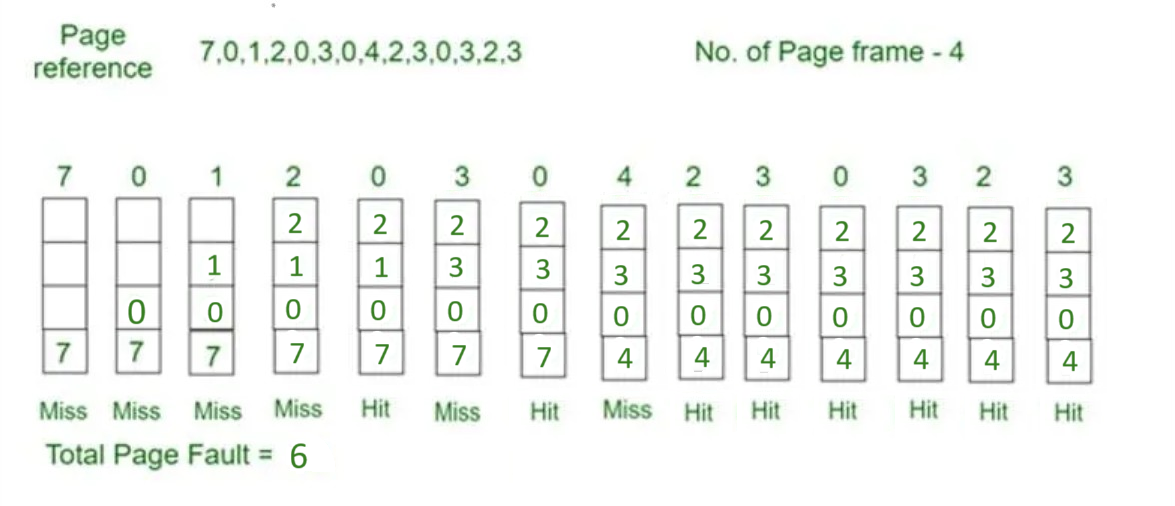
The Random Page Replacement (RANDOM) algorithm is a page replacement strategy that selects a page at random to replace when a page fault occurs and all frames are full. It does not rely on any access history or usage patterns, instead randomly choosing which page to evict.
How It Works
In the RANDOM algorithm, when a page fault occurs, the algorithm randomly picks one of the pages currently in memory to replace with the new page. The decision is entirely based on chance, with no consideration for which page was accessed most recently or how frequently pages have been used.
Advantages
- Extremely simple to implement, as no complex data structures or algorithms are required.
- Efficient in terms of implementation time and overhead.
- Can perform reasonably well in certain cases, especially when there is no clear pattern to page access.
- Does not require tracking of page usage, reducing operational complexity
Disadvantages
- Highly unpredictable, making performance difficult to analyze and optimize.
- Can perform poorly in scenarios where certain pages are accessed frequently, leading to unnecessary evictions.
- Not efficient in cases where access patterns can be leveraged (e.g., for better performance with LRU or FIFO)
- Lacks any strategy to minimize the number of page faults, often leading to a high fault rate