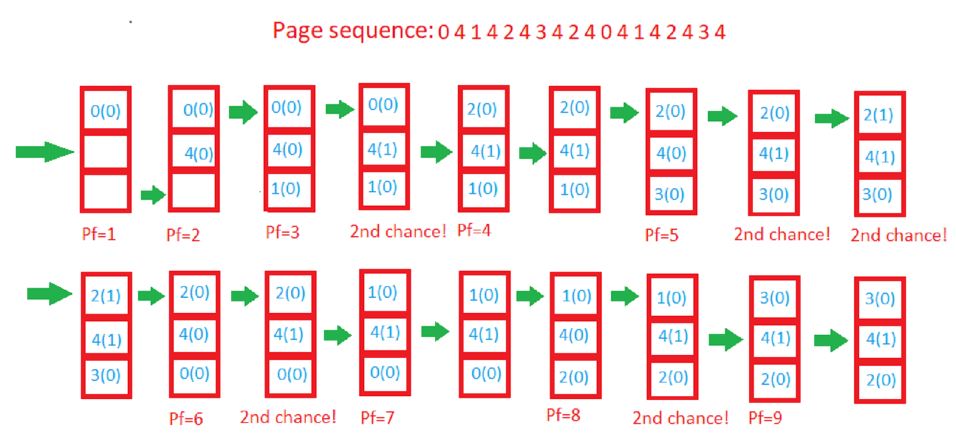
The Second Chance algorithm (also known as the Clock algorithm) is an enhancement of the FIFO page replacement strategy that takes page usage into account. It gives pages that have been recently accessed a "second chance" before being replaced, improving performance over basic FIFO.
How It Works
Second Chance maintains a circular queue of pages (like the face of a clock) with a pointer to the oldest page. Each page has a reference bit (initially set to 0) that is set to 1 when the page is accessed. When a page fault occurs:
Advantages
- Provides better performance than pure FIFO by considering page usage
- Relatively simple to implement with only minimal overhead beyond FIFO
- Prevents frequently used pages from being replaced too soon
- More efficient than LRU but with less overhead
- Does not require sorting or complex data structures
Disadvantages
- Still partially based on FIFO, so it can suffer from some of the same issues
- Only considers whether a page has been used, not how frequently or recently
- May still be susceptible to Belady's Anomaly in some cases
- Less effective than more complex algorithms like LRU for certain workloads
- Requires hardware support for reference bits to be most effective